
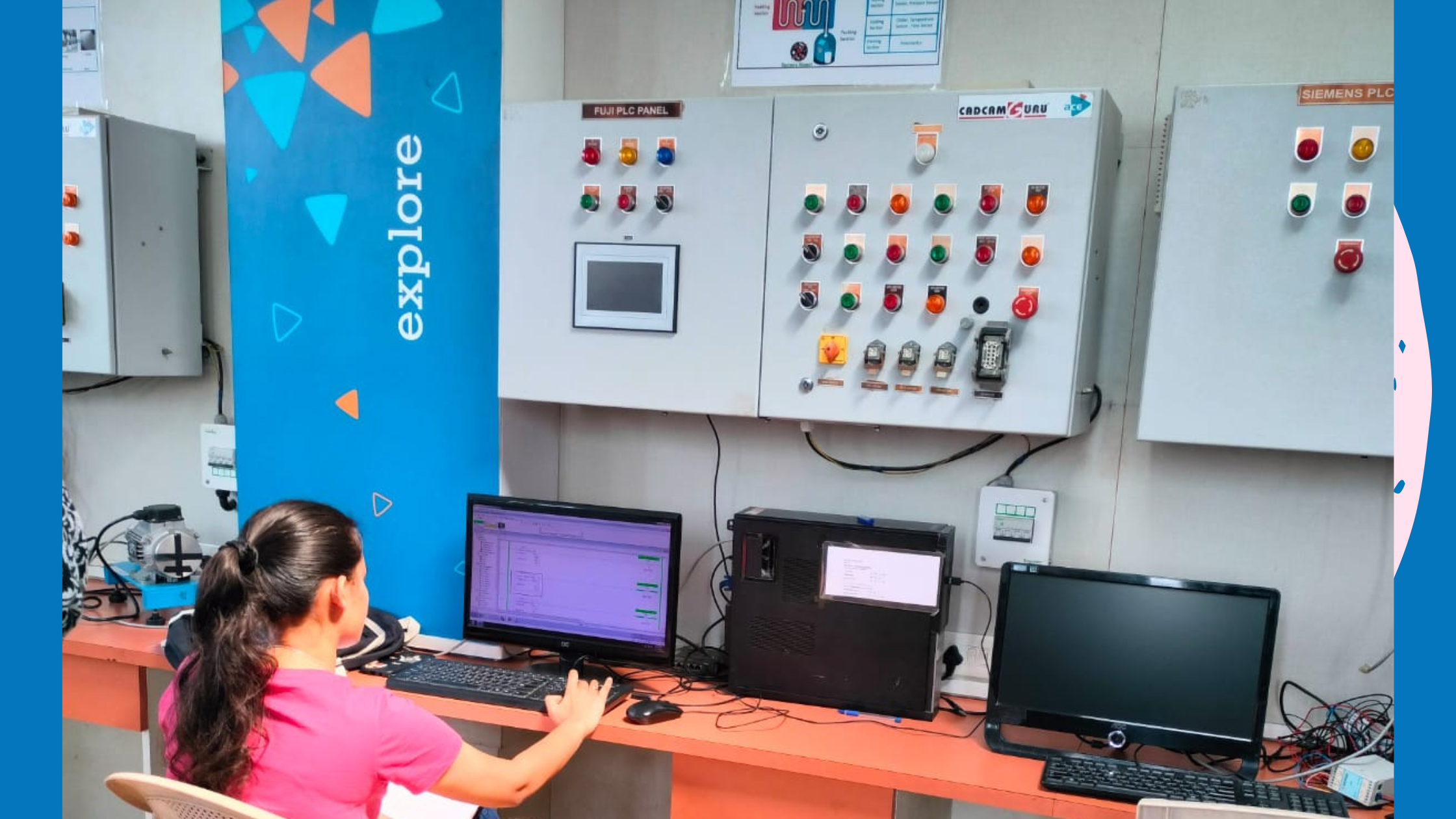
Can You Get an Automation Job Without PLC Skills?
Imagine attending an interview for an Automation Engineer position.
The interviewer asks:
“Do you know PLC programming?”
You reply:
“No, but I know basic electrical engineering.”
At this point, your chances of getting shortlisted may reduce significantly.
Why?
Because PLCs are the foundation of most modern industrial automation systems. PLCs are widely used in machine automation, conveyors, process control, and industrial manufacturing applications. [cadcamguru.com]
This raises an important question for engineering students:
Can you start a career in Industrial Automation without PLC skills?
The honest answer is:
Possible? Yes. Easy? No.
Let’s understand why.
What Is a PLC and Why Is It So Important?
PLC stands for Programmable Logic Controller.
Think of a PLC as the brain of an automated machine.
It receives signals from:
- Sensors
- Push buttons
- Switches
- Safety devices
Then it makes decisions and controls:
- Motors
- Conveyors
- Valves
- Pumps
- Cylinders
Most industrial automation systems depend on PLCs for machine control. Industries use PLCs extensively because they improve manufacturing flexibility, productivity, product quality, and troubleshooting. [cadcamguru.com]
Without PLCs, many modern factories would not function efficiently.
Where Are PLCs Used?
If you look around a modern factory, you will find PLCs almost everywhere.
Examples include:
- Automobile manufacturing plants
- Packaging machines
- Water treatment plants
- Pharmaceutical industries
- Food processing units
- Material handling systems
- Conveyor systems
PLCs are commonly used for conveyors, process control systems, building automation, and industrial machines. [cadcamguru.com]
This widespread use is one reason employers expect automation engineers to understand PLC programming.
Can You Get a Job Without PLC Knowledge?
There are some entry-level roles where PLC knowledge may not be mandatory initially.
Examples include:
- Electrical Technician
- Maintenance Trainee
- Service Technician
- Production Engineer
- Electrical Supervisor
However, career growth in industrial automation often becomes difficult without PLC skills.
Sooner or later, engineers working around automated systems are expected to understand:
- PLCs
- HMIs
- SCADA systems
- Industrial communication
- Troubleshooting
This is why many companies prefer candidates who already have PLC fundamentals.
What Recruiters Actually Look For
Many students believe recruiters only want software skills.
In reality, companies look for engineers who can understand complete automation systems.
Typical requirements include:
- PLC Programming
- Electrical Fundamentals
- Control Panels
- HMI
- SCADA
- VFDs
- Sensors and Actuators
- Troubleshooting Skills
Automation careers increasingly require knowledge of PLCs along with HMI, SCADA, and other industrial automation technologies. [cadcamguru.com], [cadcamguru.com]
Imagine Two Freshers
Candidate A
Knows:
- Basic Electrical Engineering
- Electrical Machines
- Power Systems
No PLC knowledge.
Candidate B
Knows:
- Basic Electrical Engineering
- PLC Programming
- HMI Basics
- SCADA Basics
- Industrial Automation Projects
Which candidate is likely to attract more attention from automation companies?
Most employers would prefer Candidate B because they are closer to real industrial requirements.
Why PLC Is Often the First Skill Employers Check
PLC programming gives employers confidence that a candidate understands automation logic.
It shows they can work with:
- Sensors
- Motors
- Industrial equipment
- Automated machines
More importantly, PLC knowledge helps engineers understand how modern factories operate.
For many automation roles, PLC programming is considered the starting point rather than an advanced skill.
What Happens in a Factory Without PLC Knowledge?
Let’s imagine a machine suddenly stops.
The maintenance engineer needs to determine:
- Is a sensor faulty?
- Is the PLC receiving input?
- Is the output active?
- Is the motor healthy?
- Is the VFD working properly?
Without understanding PLC logic, troubleshooting becomes much more difficult.
This is one reason why automation companies value PLC skills so highly.
PLC Alone Is Not Enough
Here’s something many students don’t realize.
Learning PLC programming is important, but PLC alone will not make you a complete Automation Engineer.
Modern industrial systems combine:
PLC
Controls machine logic. [cadcamguru.com]
HMI
Allows operators to monitor and control machines. HMIs display machine status, alarms, production counts, and operational information. [cadcamguru.com]
SCADA
Provides centralized monitoring of industrial systems and plant operations. [cadcamguru.com], [cadcamguru.com]
VFD
Controls motor speed and improves efficiency. [cadcamguru.com]
The most successful automation engineers understand how all these technologies work together.
What If You Are Starting From Zero?
If you’re still in engineering or recently graduated, don’t worry.
You can start with a simple roadmap:
Step 1
Learn electrical fundamentals.
Step 2
Learn PLC programming.
Step 3
Study HMI development.
Step 4
Understand SCADA systems.
Step 5
Learn VFD operation.
Step 6
Build automation projects.
A practical PLC and SCADA project is one of the best ways to develop hands-on automation skills. [cadcamguru.com], [cadcamguru.com]
Skills That Increase Your Chances of Getting an Automation Job
Employers often look for candidates who have exposure to:
- PLC Programming
- Ladder Logic
- HMI Design
- SCADA Systems
- VFD Configuration
- Control Panel Design
- Industrial Sensors
- Electrical Drawings
- Troubleshooting
- Automation Projects
The more of these skills you develop, the stronger your profile becomes.
Career Opportunities After Learning PLC
Once you develop PLC skills, opportunities may include:
- PLC Programmer
- Automation Engineer
- SCADA Engineer
- HMI Developer
- Commissioning Engineer
- Maintenance Engineer
- Service Engineer
- Control Panel Engineer
Industrial automation continues to create opportunities for engineers skilled in PLCs, HMI systems, SCADA, and related technologies. [cadcamguru.com], [cadcamguru.com]
So, Can You Get an Automation Job Without PLC Skills?
Technically, yes.
But if your goal is to build a strong and long-term career in Industrial Automation, learning PLC programming should be one of your top priorities.
Think of PLC as the language of automation.
Can you work in automation without knowing that language?
Possibly.
Can you grow faster if you know it?
Absolutely.
That’s why most successful automation engineers begin their journey with PLC fundamentals and then expand into HMI, SCADA, VFDs, industrial networking, and troubleshooting.
Start Your Industrial Automation Career with CADCAMGURU
At CADCAMGURU, students gain practical exposure to:
- PLC Programming
- HMI Development
- SCADA
- VFD Programming
- Control Panel Design
- Industrial Automation Projects
- Interview Preparation
👉 Apply for Industrial Automation Courses
Useful Resources:
- How to Become an Automation Engineer [cadcamguru.com]
- PLC & SCADA Project Guide [cadcamguru.com]
- Industrial Automation Overview [cadcamguru.com]
Contact Us
📞 +91 9168603427 / +91 9168601733
📧 enquiry@cadcamguru.com
