
Introduction
In product design, even small dimensional variations can affect the performance and assembly of components. This is where tolerance analysis becomes essential. It ensures that all parts fit together correctly, even when slight manufacturing variations occur.
What is Tolerance Analysis?
Tolerance analysis is the process of evaluating how variations in part dimensions impact the final assembly.
In simple words:
It checks whether parts will still function properly even when they are not manufactured to exact dimensions.
Why Tolerance Analysis is Important
1. Ensures Proper Fit and Assembly
Tolerance analysis helps prevent issues like tight fits or loose assemblies.
Ensures smooth assembly of components.
2. Improves Product Quality
By controlling variations, designers can maintain consistent product performance.
3. Reduces Manufacturing Cost
Avoids unnecessarily tight tolerances, which are expensive to produce.
Balances cost and precision effectively.
4. Minimizes Assembly Failures
Detects potential problems before manufacturing begins.
Reduces rework and wastage.
5. Enhances Product Reliability
Proper tolerance allocation improves durability and functionality.
Simple Example
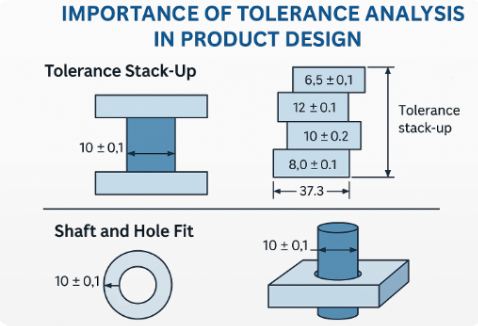
Example: Shaft and Hole Fit
- If the shaft is too large, → It won’t fit
- If the hole is too big, → It becomes loose
Tolerance analysis ensures the correct fit (clearance, transition, or interference).
Where It is Used
- Automotive components
- Aerospace parts
- Machine assemblies
- Consumer product design
Conclusion
Tolerance analysis plays a critical role in product design by ensuring fit, function, quality, and cost-effectiveness. For mechanical engineers, mastering this concept is essential to create reliable and manufacturable products.
