GD&T is one of the most important topics for mechanical design interviews. Many freshers learn CAD software like CATIA, SolidWorks, Creo, or NX CAD, but interviews test how well you understand GD&T and engineering drawings.
If you are a mechanical fresher and have learned GD&T, this blog will help you prepare with the most commonly asked CAD interview questions in simple English.
1. What is GD&T and why is it used
GD&T stands for Geometric Dimensioning and Tolerancing. It is used to define the shape, size, orientation, and location of a part accurately. GD&T helps in clear communication between design, manufacturing, and inspection teams.
2. What are the advantages of GD&T over normal dimensions
GD&T gives more design control, allows higher manufacturing tolerance, reduces rejection, and improves part quality. It also avoids confusion in drawings.
3. What is a datum and why is it important
A datum is a reference point, line, or surface used to measure dimensions. Datums help maintain consistency in manufacturing and inspection.
4. What is a datum feature
A datum feature is the actual physical feature of a part like a surface or hole that is used to establish a datum.
5. What is feature control frame
A feature control frame is a rectangular box that contains GD&T symbols, tolerance values, and datum references. It defines how a feature is controlled.
6. What is the difference between form and orientation tolerances
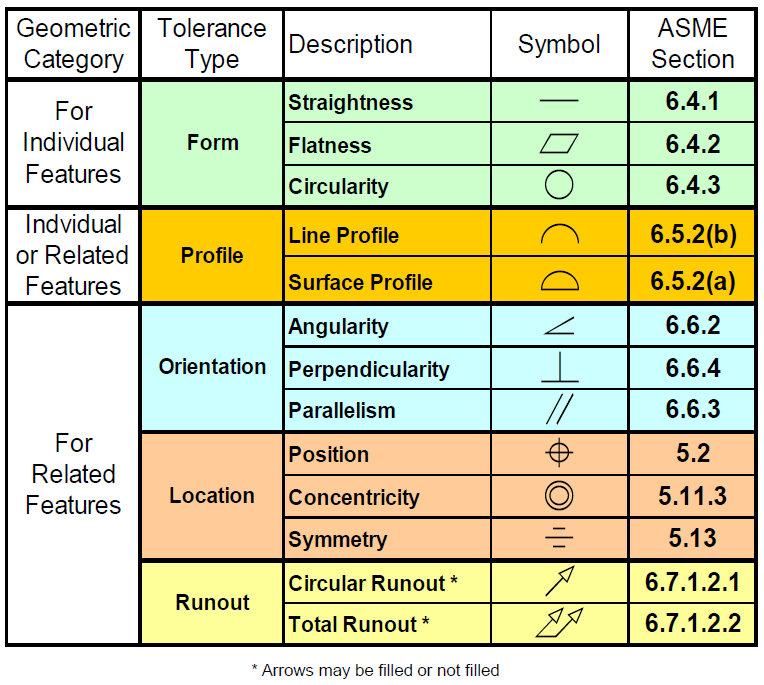
Form tolerances control shape and do not need a datum. Examples are flatness and circularity. Orientation tolerances control alignment and need a datum. Examples are parallelism and perpendicularity.
7. What is the difference between location and profile tolerances
Location tolerances control the position of features like holes. Profile tolerances control the shape of complex surfaces.
8. What is flatness tolerance
Flatness controls how flat a surface must be. It does not require a datum and is used when surface quality is critical.
9. What is perpendicularity
Perpendicularity controls how close a feature is to 90 degrees relative to a datum.
10. What is position tolerance
Position tolerance controls the exact location of holes or features relative to datums. It is one of the most commonly used GD&T controls in industry.
11. What is MMC and LMC
MMC means Maximum Material Condition and LMC means Least Material Condition. These conditions help allow bonus tolerance and reduce manufacturing cost.
12. What is bonus tolerance
Bonus tolerance is extra tolerance gained when a feature departs from MMC. It improves part acceptance and flexibility.
13. What is circularity and cylindricity
Circularity controls the roundness of a circle in a cross-section. Cylindricity controls the overall roundness and straightness of a cylinder.
14. How is GD&T useful in mass production
GD&T ensures interchangeability of parts, reduces rejection, and maintains consistent quality in mass production industries like automotive and aerospace.
15. What mistakes freshers make while using GD&T
Common mistakes include over-tolerancing, wrong datum selection, incorrect symbols, and using GD&T without understanding function.
Bonus Interview Tip for Freshers
Interviewers do not expect freshers to know everything. They expect clarity of basics. If you explain GD&T with functional logic, you already stand out.
How CADCAMGURU Prepares You for CAD Interviews
CADCAMGURU focuses on:
-
Strong engineering drawing fundamentals
-
Practical GD&T with real components
-
Industry-based CAD projects
-
Interview-oriented questions and answers
This approach helps mechanical freshers gain confidence and job readiness. For updated course fees and details, always visit the official CADCAMGURU website.
